
Essentials of
Trauma Patient
Master the trauma patient in six weeks - so when one comes through the door barely holding on, you know exactly what to do first.
12 CPD points (RACE & AVA approved)
Secure your spot




Most of us don't struggle with trauma because we don't know enough. We struggle because everything happens at once - the patient is unstable, the owner is panicking, and there's no specialist standing next to you telling you what to do first. The difference between a case that goes well and one that haunts you is rarely a single fact. It's knowing what to reach for, in what order, while everything is moving. That's exactly what this course is built to teach.
- 6-week guided online program with 6 months total access
- 12 CPD points, RACE and AVA approved
- Direct Q&A with a board-certified specialist
- Downloadable protocols & checklists
- Interactive quizzes, case studies & practical scenarios
- Personalised certificate upon passing the final exam


Dr Franziska Meyer Dr. med. vet. DACVECC
Dr Franziska Meyer graduated from the University of Bern and completed advanced training in emergency and critical care at the University of Bern and Washington State University. She is a Diplomate in Small Animal Emergency and Critical Care and a Senior Lecturer at the University of Zurich.
Franzi is known for her approachable teaching style and her passion for helping veterinarians feel more confident in emergencies. Whether in the lecture hall or the clinic, her focus is on clear explanations, practical strategies, and genuine support.
What you'll learn, week by week
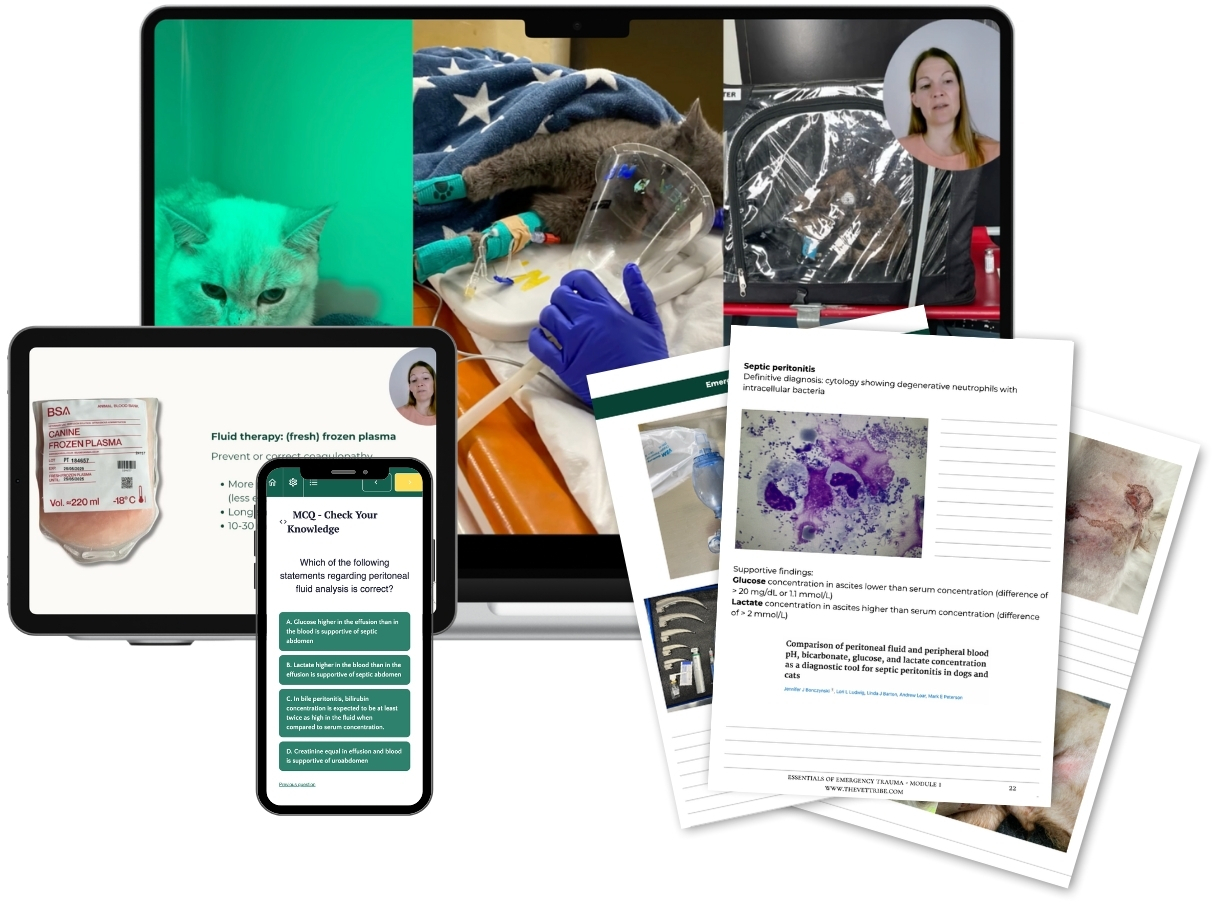
Assessment of the Trauma Patient
- Triage effectively, both over the phone and when the patient arrives
- Use a structured ABCD primary survey to spot and treat the most urgent problems first
More about this module ▼
- Use bedside ultrasound (AFAST/TFAST) and basic blood tests to get critical answers fast
- Recognise shock and life-threatening bleeding, and know when to reach for blood products
- Provide pain relief safely, even in unstable patients
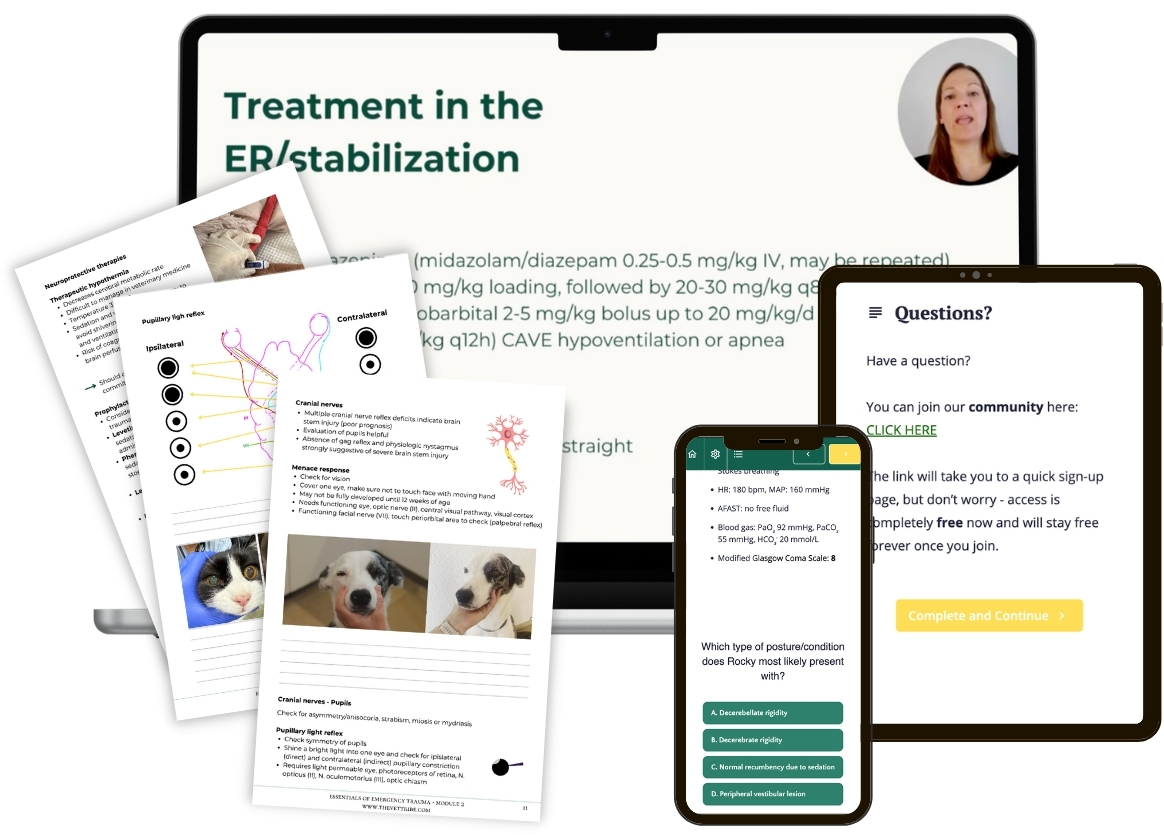
Traumatic Brain Injury
- Recognise TBI when it's not obvious, and when to suspect it from the trauma history
- Work through the neurological exam step by step, including the modified Glasgow Coma Scale
More about this module ▼
- Understand primary vs secondary brain injury and why early intervention matters
- Manage intracranial pressure with hyperosmolar therapy (mannitol or hypertonic saline)
- Know when to use imaging and how to interpret findings
- Stabilise safely: oxygen, fluid therapy, seizure control and careful analgesia
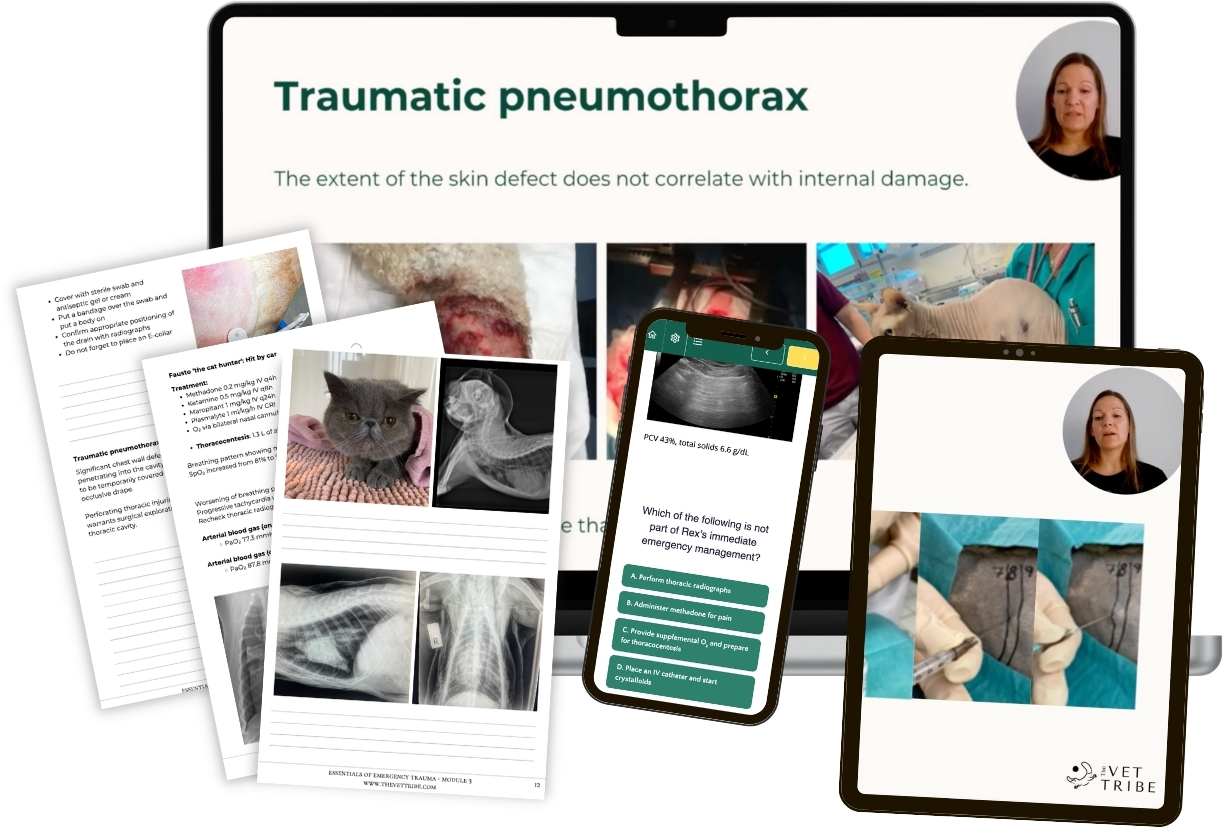
Respiratory Trauma
- Spot and differentiate pneumothorax, lung contusions, diaphragmatic hernia, rib fractures and airway tears
- Use oxygen therapy effectively, including when to escalate to high-flow oxygen or intubation
More about this module ▼
- Perform thoracocentesis and place chest drains step by step, staying calm under pressure
- Manage pain safely without compromising breathing
- Recognise look-alike conditions that cause tachypnea but aren't true respiratory emergencies
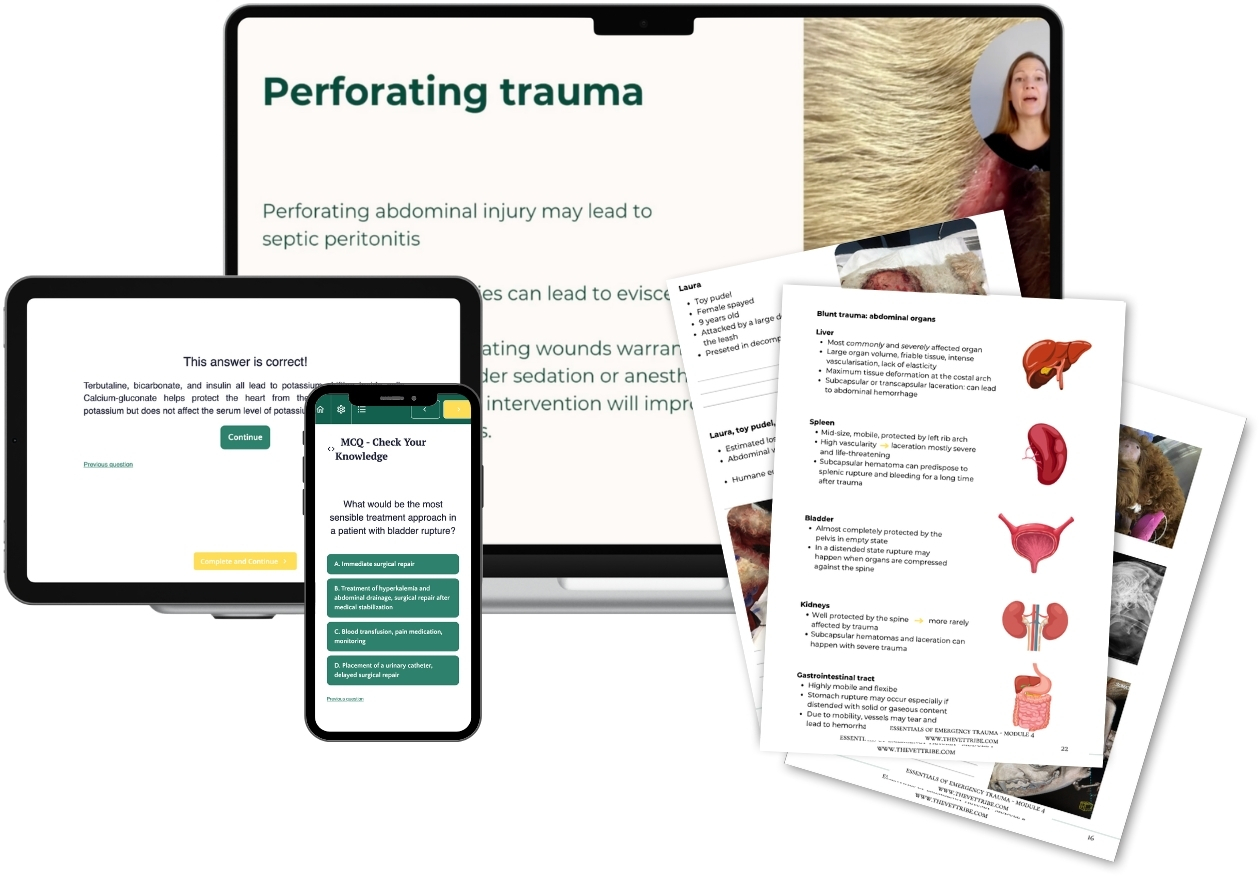
Abdominal Trauma
- Differentiate blunt from penetrating trauma and understand their common injury patterns
- Use AFAST, radiographs and contrast studies to diagnose hemoabdomen, uroabdomen, diaphragmatic hernia and GI perforation
More about this module ▼
- Recognise when free fluid is blood, urine, bile or septic exudate, and why it matters
- Stabilise patients with haemorrhage or electrolyte derangements, including transfusions and severe hyperkalaemia
- Plan for surgical intervention when indicated, and set realistic expectations with owners
Complications in Polytrauma
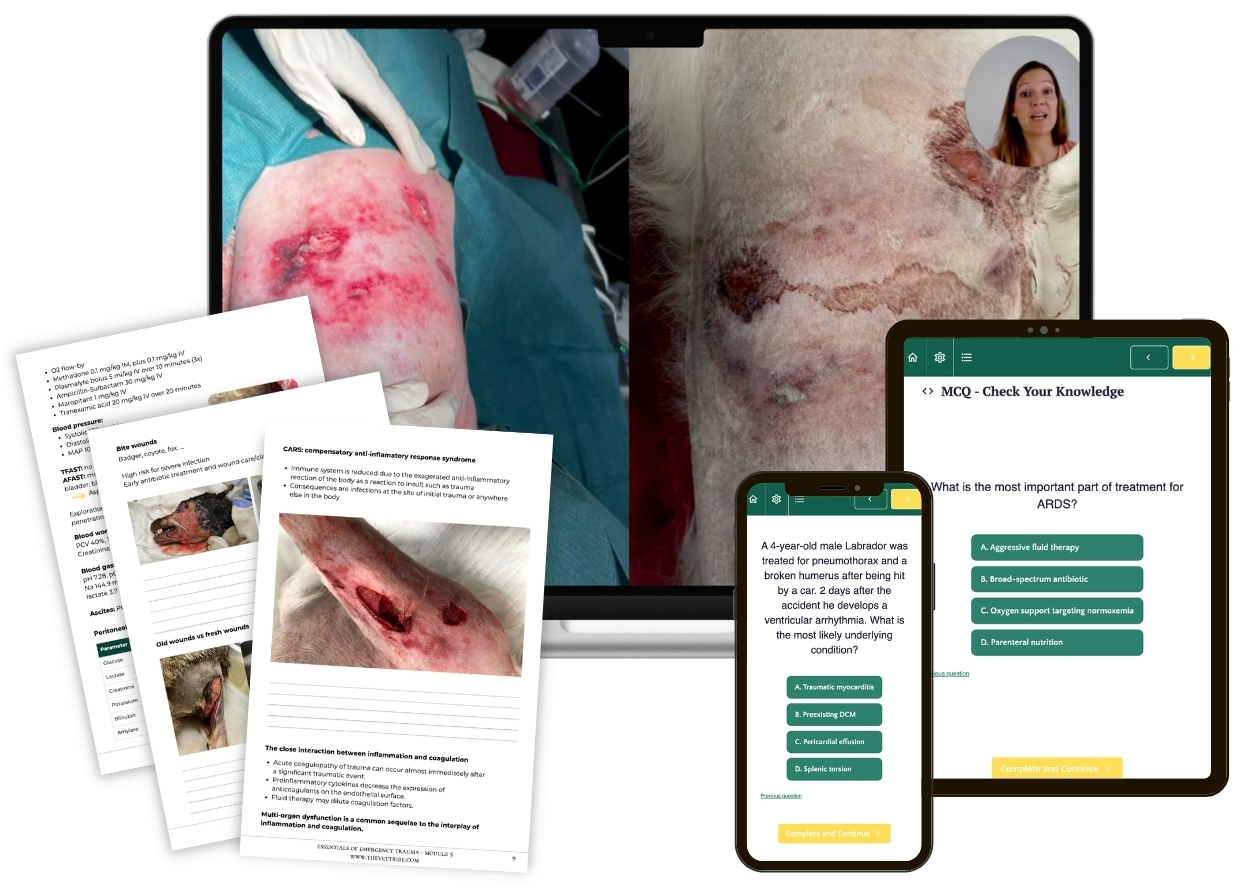
- Recognise patterns of injury in road traffic accidents, falls and severe bite wounds
- Understand the second-hit effect: how inflammation, coagulopathy and reperfusion injury spiral into organ failure
More about this module ▼
- Approach decision-making around surgery timing and damage-control stabilisation
- Manage acute respiratory distress syndrome, trauma-induced coagulopathy and sepsis
- Choose fluids, analgesia and transfusions wisely to support recovery without adding risk
Week 6 Examination
Every step is designed to help you learn faster, remember more, and act with confidence in the clinic.
Start with a quiz
Each module begins with a quick quiz to see what you already know.
Learn from specialists
Short, practical videos from a board-certified specialist.
Take notes in your workbook
Download the module workbook to capture key points and charts.
Quizzes & case studies
Go through case studies and apply your knowledge in realistic scenarios.
Ask your questions
Post in the community - specialists have your back.
Extra tools & resources
Protocols, articles, tables and guides if you want to dig deeper.

Learn from Anywhere
Join today, learn online at your own pace. 6 weeks of guided modules + 6 months access.

Ask Questions
Not just video lessons - mentors are present to answer your questions as you learn.

Video Lessons
Over 12 hours of training in short 5-20 minute videos for any schedule.

Learning Materials
Downloadable notes, diagrams, drug charts and a workbook.

Track Progress
Pre- and post-module MCQs that measure progress and keep knowledge sharp.

Case Studies
Realistic scenarios to help you apply skills in real-world contexts.

24/7 Community
A private space where vets connect and learn together.

Exam & Certificate
Pass the online MCQ exam with 70%+ to earn your official certificate.
Your mentors aren't just names on a screen
Throughout the course, you can post your questions directly inside the platform and get clear, practical answers from board-certified specialists. You're never working through it alone.
You don't have to take our word for it. Here are a few words from vets and students who have already joined.
"I tried out the trauma course myself and learnt so much across the modules, with videos on how to assess trauma and what to do, plus case examples that apply to real life situations."
"I loved that the course was self-paced, so I could still complete it amongst my busy schedule. The interactive case studies were very valuable, as this is my favourite way to learn."
Want to hear more from our vets? See all testimonials
Pick your start date and save your spot
We run Essentials of Trauma in small guided cohorts so Dr Meyer and the team can properly support everyone and answer real clinical questions along the way. Enrolment for the next cohort is open now, and you get full access the day yours begins - so you can plan your six weeks around the shifts you're already working. Once a cohort's start date passes, the next chance to join is the following month.
Select your start date
Choose how to pay
Your cohort starts on its scheduled date, and that's the day your access opens and Module 1 unlocks. From there, a new module unlocks each week across the six weeks of guided learning, so you have time to absorb each topic before moving on. You keep full access to every recording and resource for six months, so you can revisit lessons and protocols whenever a real case calls for it. Throughout your cohort, Dr Meyer and the team are there in the community to answer your questions - you're never working through it alone.
GUARANTEE
We've got your back
We believe in the quality of our courses and we stand behind them. If you start your intake and decide it isn't the right fit, just let us know before Module 2 unlocks and we'll refund you in full - no questions asked. You only stay if this genuinely helps you in practice.
This course is for you if...
- You want a step-by-step trauma approach you can rely on when seconds matter
- You're a vet or final-year vet student who wants to feel calm and in control
- You prefer practical, case-based learning over theory-heavy lectures
- You want checklists, decision trees and drug plans you can use tomorrow
- You want to learn directly from a board-certified specialist, without the fluff
This course is not for you if...
- You're not a veterinarian or vet student
- You're looking for a casual, theory-heavy course with no application to real cases
- You prefer live-only teaching over structured, on-demand learning
- You're not ready to commit to practising what you learn through quizzes and case studies
Why learn from Dr Franziska Meyer?
- Board-certified specialist - Diplomate of the American College of Veterinary Emergency and Critical Care (DACVECC)
- Advanced training in Europe & the USA - ECC training at the University of Bern and Washington State University
- Dedicated educator - Senior Lecturer at the University of Zurich, known for making complex topics clear and practical
- Real-world specialist - brings experience from managing trauma patients daily in university and clinical settings
- Approachable mentor - valued for her calm, supportive teaching style
Traumatic Brain Injury: Mannitol vs Hypertonic Saline
We'll send the Open Protocols: Trauma PDF straight to your inbox, plus a free video lesson on choosing mannitol vs hypertonic saline in TBI. Created and taught by Dr Franziska Meyer DACVECC.
Get the free lesson →
Essentials of Trauma Patient
Learn with Dr Franziska Meyer DACVECC and build the confidence to assess and stabilise trauma patients when every second counts.
- 6-week guided learning, 6 months access
- Over 12 hours of training in short videos
- Direct Q&A with a board-certified specialist
- Interactive case studies, quizzes & protocols
- Certificate after passing the final exam
- 24/7 access to The Vet Tribe community
When does my course start?
Your course starts on the day your chosen cohort begins - you'll see the available start dates in the enrolment box above. That's the day your access opens and Module 1 unlocks. A new module then unlocks each week across the six weeks.
Are the lessons live?
No. All teaching is delivered as pre-recorded videos (5-20 minutes each) grouped into weekly modules, about two hours of content per module. No time-zone clashes and no 5 a.m. alarms.
Do I get all modules at once?
No. The course releases one module each week so you have time to absorb each topic. Module 1 unlocks the day your cohort starts, then a new module every seven days. You keep access to all content for six months from your cohort start date.
Will I have contact with the mentor?
Yes. You'll be part of The Vet Tribe Community on our website or app, where you can ask questions and get answers from mentors and the wider community. You won't be learning alone.
How long do I keep access?
You'll have full access for six months from your cohort start date. Learn at your own pace, revisit modules, and stay connected the whole way through.
Have more questions? Visit our full FAQ page or get in touch - we're happy to help.
Join the Essentials of Trauma Patient online course
Learn with Dr Franziska Meyer DACVECC and build the confidence to manage trauma patients when every second counts. Secure your spot while places last.
Secure your spot