The Vet Tribe - Essentials of Emergency
Online course for veterinarians

Essentials of Emergency

Six weeks with a board-certified specialist that give you a clear plan to run when an emergency comes through the door.

Dr Rebecca Walton DVM DACVECC
6-week guided learning · 6 months access
12 CPD points (RACE & AVA approved)
Next cohort starts Monday 6 July
-- left to join

Secure your spot
Officially approved CPD points provider
RACE/AAVSB AVA Canada CPD New Zealand VCA RCVS
Why this matters

Emergency medicine rarely gives you a quiet moment to think. A patient crashes, the phone keeps ringing, and three cases need you at once, all while the clock is running. Even the most experienced vets will tell you the hard part isn't the knowledge, it's holding it all together when everything happens at once and there's no one beside you to talk it through. This course gives you a clear system to fall back on in those moments, so you can triage fast, catch shock early, stabilise with what you have on hand, and stay in control of the room no matter how the shift unfolds.

What's inside the course
  • 6-week guided online program with 6 months total access
  • 12 CPD points, RACE and AVA approved
  • Direct Q&A with a board-certified specialist
  • Downloadable protocols & checklists
  • Interactive quizzes, case studies & practical scenarios
  • Personalised certificate upon passing the final exam
What's inside the course
Meet your mentor
Mentor photo

Dr Rebecca Walton DVM DACVECC

American Board-Certified in Emergency Medicine and Critical Care

Dr Rebecca Walton is a board-certified specialist in Emergency and Critical Care and Head of a Critical Care Department in Los Angeles. She has over a decade of clinical and academic experience, including seven years as a Clinical Professor at Iowa State University.

Rebecca is known for her warmth, clarity and exceptional teaching, with over 40 peer-reviewed publications, multiple book chapters and leadership roles in ECC education. She helps shape the field's clinical standards as a contributor to the RECOVER CPR guidelines, Project Lead for the VetCOT trauma clinical guidelines, and Chair of the ACVECC Residency Training Committee. Whether in the lecture hall or the clinic, her focus is on clear explanations, practical strategies, and genuine support.

"Emergency work is hard: emotionally, intellectually and logistically. But it is also incredibly rewarding. My goal is to give vets the structure and confidence they need to make fast, safe decisions when the stakes are high."
Meet Dr Becca
Course plan at a glance

What you'll learn, week by week

Week 1

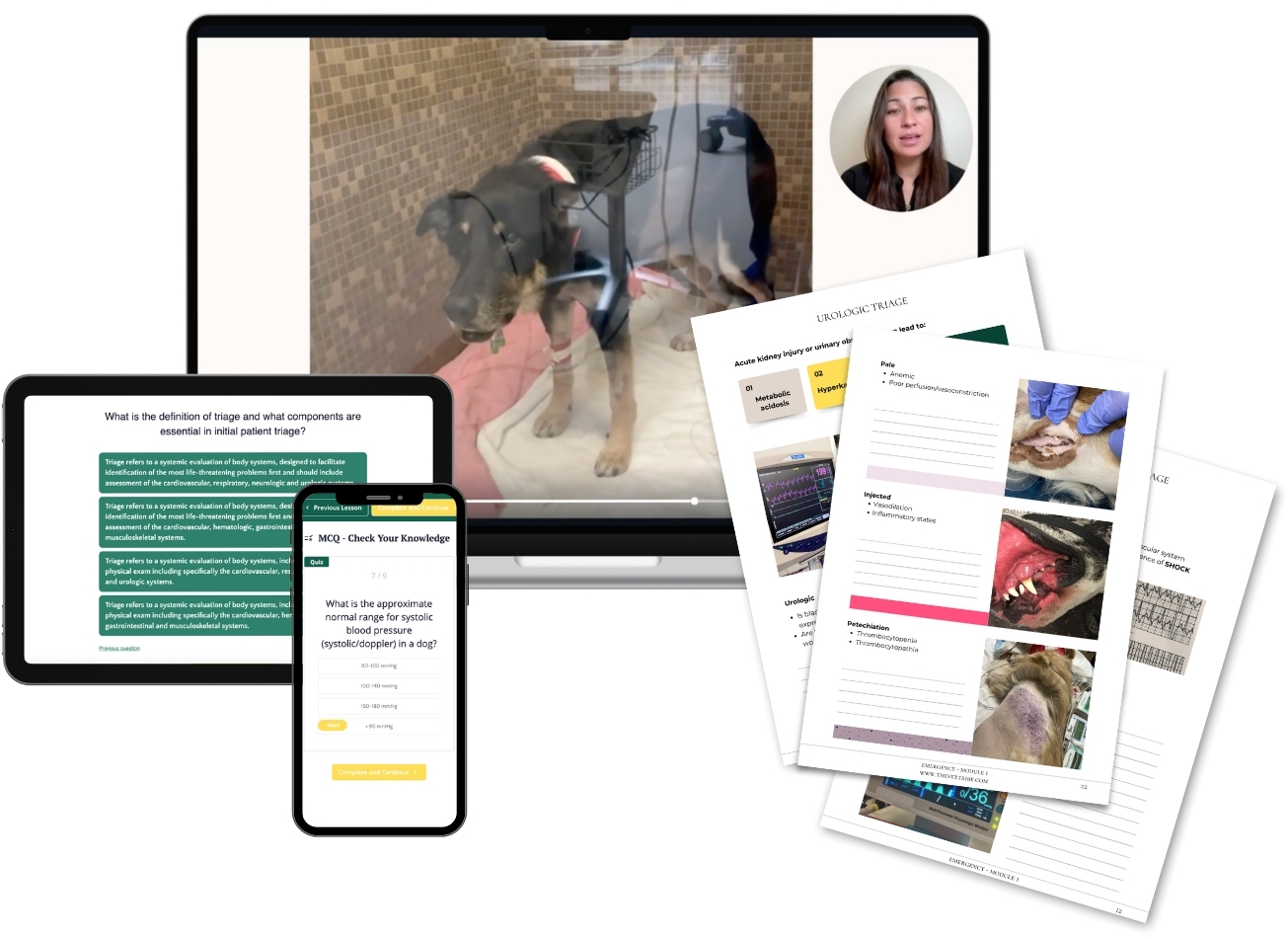
Triage

Sort fast. Think clearly. Stay organised.
This module teaches you how to assess patients quickly and accurately, both over the phone and in the clinic - so you can triage in under two minutes, identify life-threatening conditions, and communicate confidently with owners.
What you will master inside this module:
  • Triage scoring systems
  • Cardiovascular, respiratory, neurologic and urologic triage
  • Managing multiple emergencies at once
More about this module
  • Phone and front desk triage
  • Vital signs and the primary survey
Lessons in this module
Lesson 1
Introduction and Phone TriageSet the stage for effective emergency care from the very first call. Learn how to guide worried owners, identify true emergencies early, and use focused questions to gather the details you need before the patient walks through the door.
Lesson 2
Triage ExamplesSee theory in action with real-world examples of common presentations - from trauma to toxin ingestion - so you recognise red flags, prioritise cases and sharpen your clinical reasoning.
Lesson 3
Triage ExamMaster a fast, structured triage exam, covering each step of the primary and secondary survey so you spot life-threatening problems quickly and respond with purpose.
Lesson 4
Cardiovascular TriageAssess the cardiovascular system in a crisis - pulse quality, heart rate, mucous membranes and other critical findings that guide your next steps in stabilising a patient.
Lesson 5
Respiratory TriageRecognise respiratory distress before it escalates. Evaluate breathing patterns, detect cyanosis, and decide when oxygen therapy or urgent intervention is needed.
Lesson 6
Neurologic TriageSharpen your neurologic assessment under pressure - how mentation, posture and reflexes help you identify underlying emergencies and prioritise care.
Lesson 7
Urologic TriageDetect and manage urologic emergencies, with the key signs of urinary obstruction and how to differentiate stable from unstable cases.
Lesson 8
Goal of TriageBring it all together with a clear focus on what triage is meant to achieve - how rapid assessment, teamwork and clear communication improve outcomes for even the most critical patients.
Lesson 9
CasesApply what you've learned in interactive case discussions that reinforce decision-making and show how to move from assessment to action with confidence.
By the end of this module, you will feel prepared to triage quickly, keep several emergencies moving at once, and stay on top of the room even when it gets busy.
Week 1
Week 2
Week 2

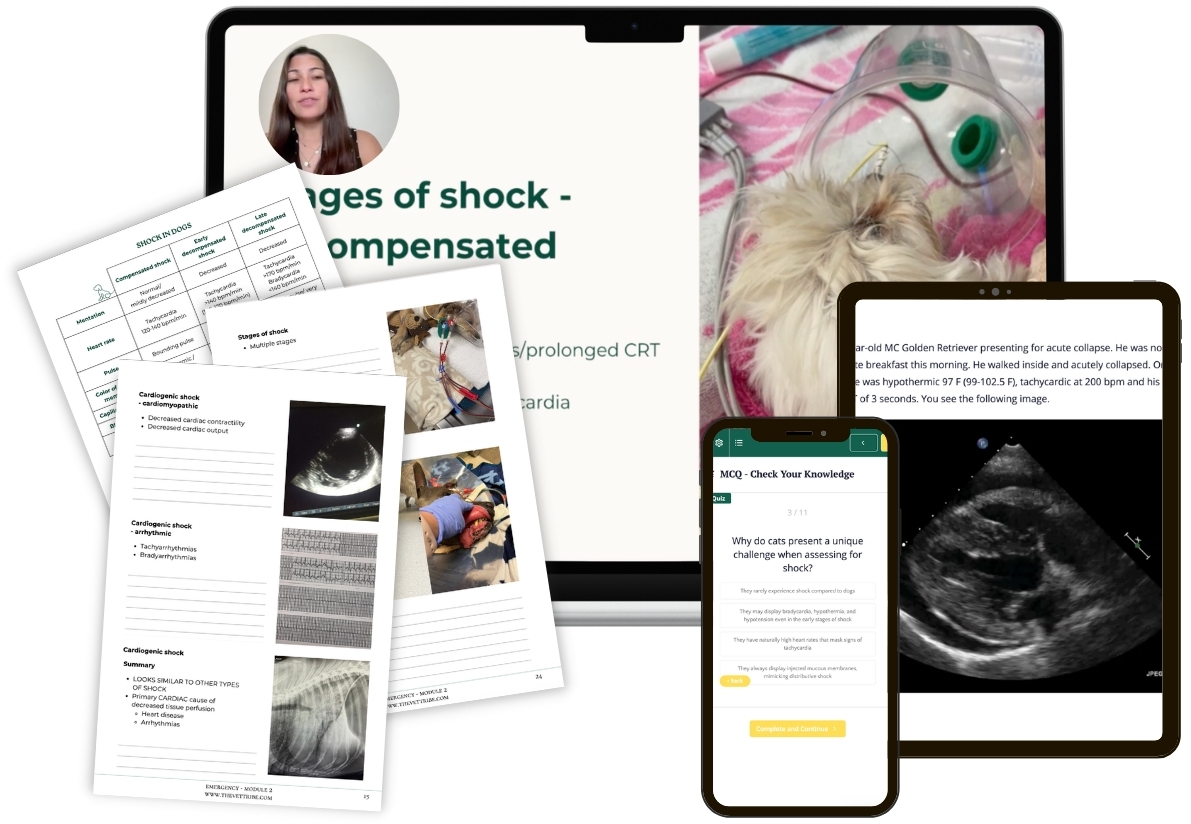
Shock

Recognise quickly. Intervene early. Save lives.
Understand the four types of shock, how they present, and what to do when every second matters.
What you will master inside this module:
  • Types of shock: hypovolaemic, distributive, cardiogenic and obstructive
  • Clinical signs and subtle indicators
  • The stages of shock, from compensation to decompensation
More about this module
  • The pathophysiology behind each type
  • Prioritising patient needs and managing client communication
Lessons in this module
Lesson 1
ShockLearn what shock really means on a cellular level and why early recognition saves lives - the physiology of poor perfusion, oxygen delivery and energy failure, in simple, practical terms.
Lesson 2
Patient #1Dive into distributive shock through a focused case study - the key signs of vasodilation and how to differentiate it from other shock types in a crisis.
Lesson 3
Patient #2Explore cardiogenic shock step by step - how heart failure leads to poor perfusion and why these patients need a different treatment approach.
Lesson 4
Patient #3Review obstructive shock in a clear, case-based discussion - how conditions like GDV or pericardial effusion block circulation, and what to do first.
Lesson 5
Patient #4Practise sorting stable from unstable patients, reinforcing the importance of trends, reassessment and staying alert to subtle changes.
Lesson 6
Stages of ShockUnderstand the progression from early compensation to decompensation and irreversible damage, so you can recognise the stage and respond effectively.
Lesson 7
Clinical SignsGet confident identifying the outward signs of shock - from mucous membrane colour to pulse quality - and exactly what to look for.
Lesson 8
Client CommunicationExplain shock to worried owners clearly and compassionately, with tips for discussing prognosis, costs and urgency in a way that builds trust.
Lesson 9
PrognosisExplore what factors influence survival and recovery, so you can set realistic expectations and make informed recommendations.
Lesson 10
Most Common QuestionsGet answers to the questions vets hear most often about shock - quick, practical guidance to help you feel prepared in any conversation.
By the end of this module, you will feel prepared to confidently identify the different types of shock, understand their pathophysiology, and know exactly how to start treating them fast - even when the diagnosis is still evolving.
Week 3

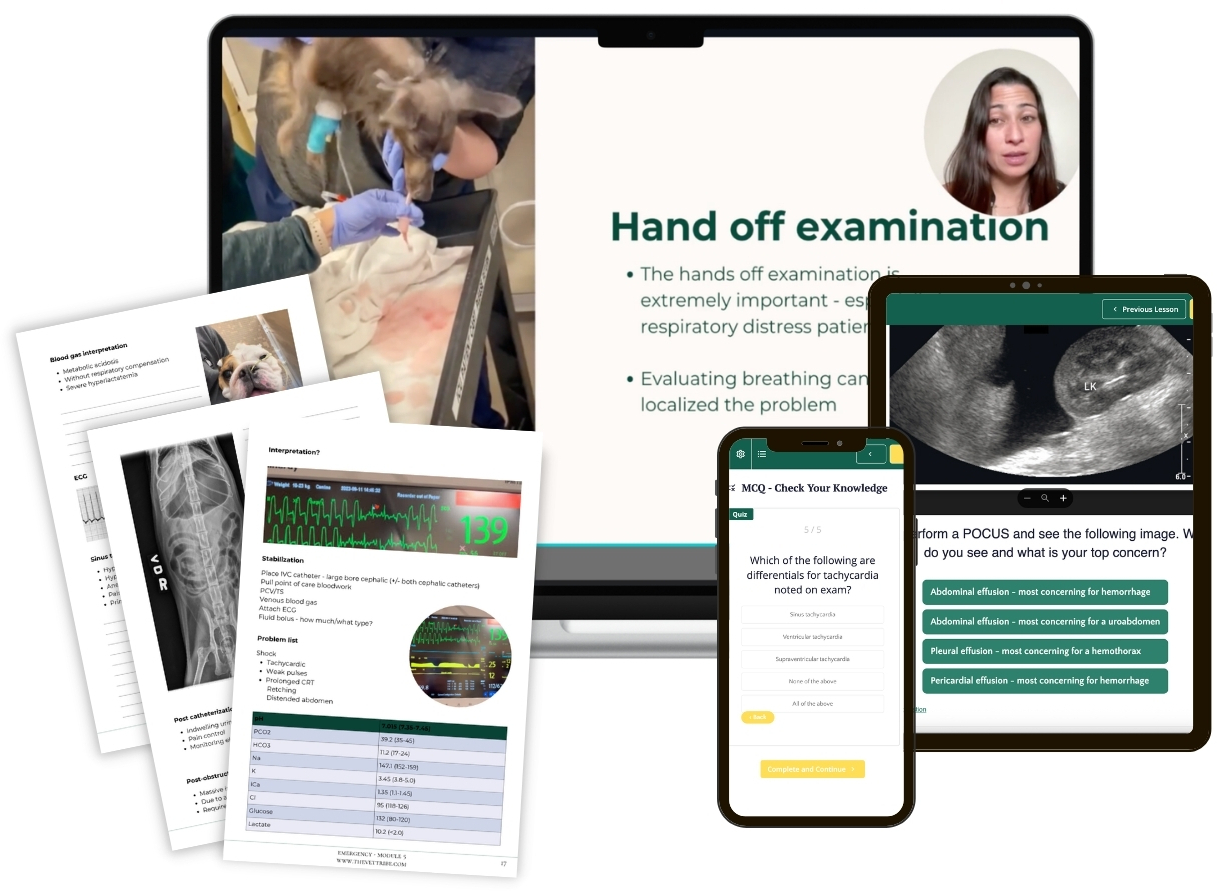
Point-of-Care Diagnostics & Stabilisation

Use what you have. Stabilise what you can.
Master the tests and treatments that can be done immediately, even before full workups - using the tools you already have to get rapid, meaningful answers.
What you will master inside this module:
  • How to use PCV/TP, glucose, lactate, blood smear and acid-base analysis
  • POCUS: when and how to use it
More about this module
  • Interpreting sodium, potassium, calcium and magnesium
  • Initial oxygen therapy, pain control and triage-based decision making
  • Early stabilisation tips for the unstable patient
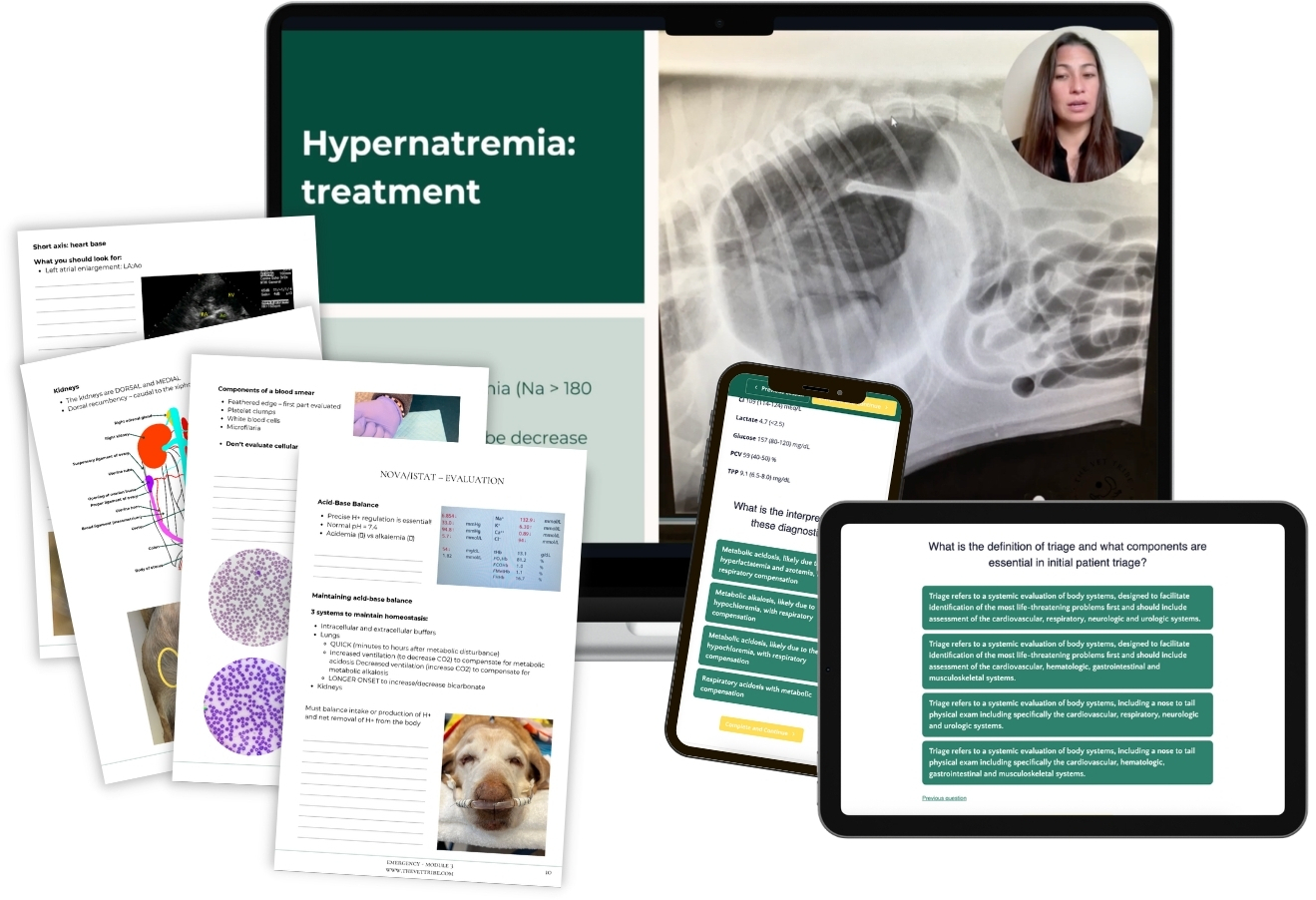
Lessons in this module
Lesson 1
Point of Care DiagnosticsQuickly gather the most important data when minutes count - the essential tools and techniques for bedside testing in emergency cases.
Lesson 2
NOVA / ISTAT EvaluationInterpret NOVA and ISTAT results confidently, covering acid-base balance, electrolytes and the critical parameters that guide immediate treatment decisions.
Lesson 3
SodiumDetect and manage sodium imbalances in emergency patients - the causes, risks and correction strategies, step by step.
Lesson 4
PotassiumUnderstand why potassium matters in critical care - how to recognise hyperkalaemia and hypokalaemia and act quickly to protect your patient's heart.
Lesson 5
CalciumReview the role of calcium in stabilising your patients - how to spot abnormalities, interpret their impact and plan appropriate interventions.
Lesson 6
MagnesiumUnderstand the importance of magnesium in emergencies - when to test, how to supplement, and why this overlooked electrolyte can make a big difference.
Lesson 7
POCUS - Point of Care UltrasoundBuild confidence using ultrasound at the bedside - techniques for detecting effusions, evaluating the heart and guiding procedures safely.
Lesson 8
Beyond TraumaExplore the many ways point-of-care ultrasound helps beyond trauma cases - applying it in medical emergencies, shock and complex presentations.
Lesson 9
Organ Identification and EchotextureDevelop your eye for ultrasound anatomy - recognising organs, assessing their structure and detecting abnormalities efficiently.
Lesson 10
StabilisationBring diagnostics and action together with a clear, stepwise approach to stabilising critical patients based on your findings.
By the end of this module, you will feel prepared to stabilise patients even before full workups are available.
Week 3
Week 4
Week 4

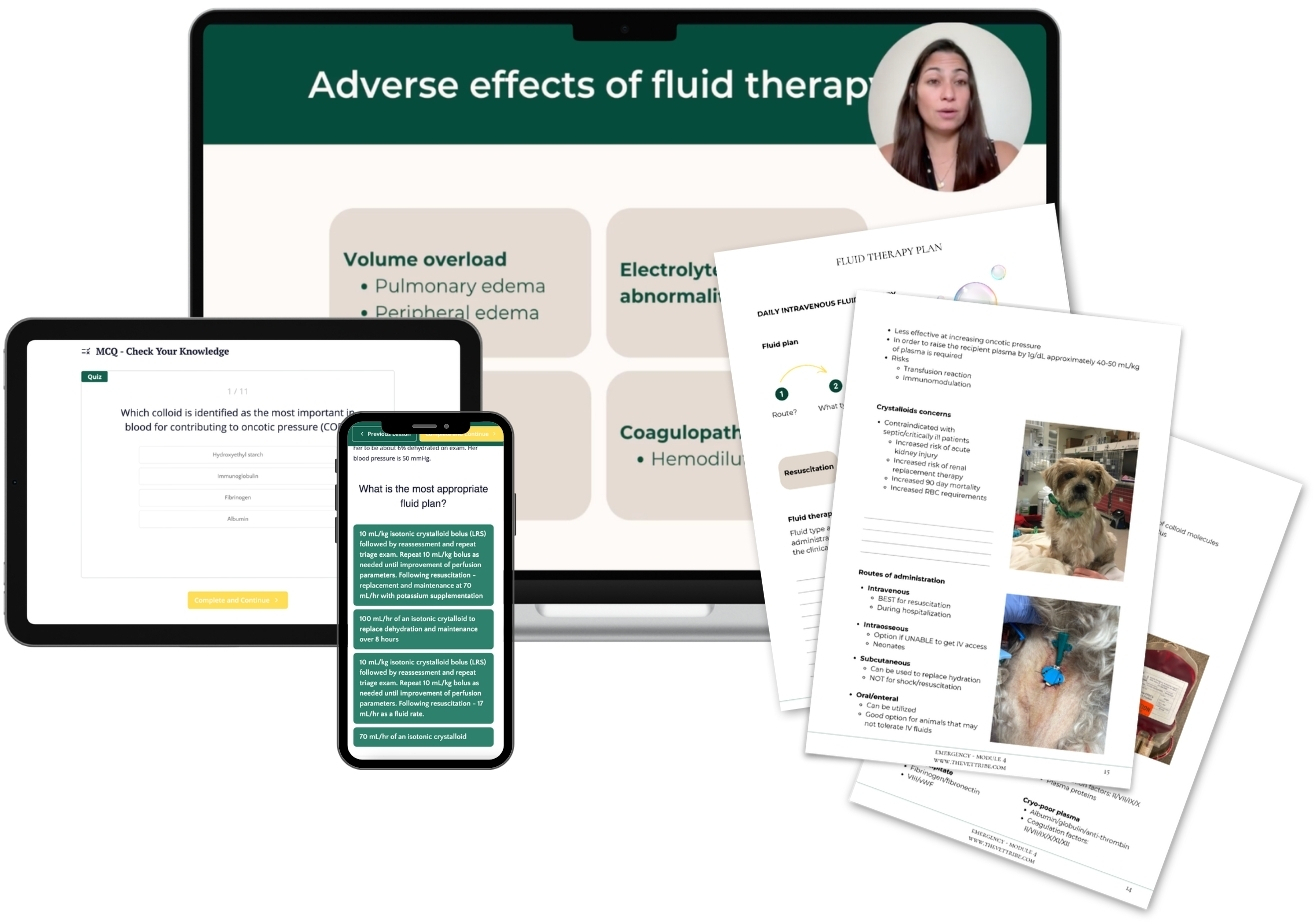
Fluid Therapy

Fluids save lives. Learn to use them wisely.
Not all fluids are created equal. This module gives you the confidence to choose the right fluid, at the right rate, for the right patient.
What you will master inside this module:
  • Types of fluids and when to use them
  • Understanding crystalloids vs colloids
More about this module
  • Calculating doses and rates
  • Adjusting plans for different shock states
  • Troubleshooting adverse responses and spotting when things go wrong
Lessons in this module
Lesson 1
The Basics of Fluid TherapyGet grounded in the core principles - why fluids are used, how they move through the body, and the goals you're working toward in each patient.
Lesson 2
Assessment of HydrationMaster evaluating hydration status - which physical exam findings matter most and how to interpret them accurately under pressure.
Lesson 3
Fluid TypesUnderstand the options in your fluid bag - the differences between crystalloids, colloids, hypertonics and maintenance solutions, so you choose confidently.
Lesson 4
Adverse EffectsRecognise and prevent complications from fluid therapy - overload, electrolyte shifts and other risks to watch for.
Lesson 5
Route of Fluid AdministrationReview the pros and cons of each route - intravenous, intraosseous and subcutaneous - and when and how to use each effectively.
Lesson 6
Fluid Therapy PlanBuild stepwise plans tailored to each patient - calculating rates, setting goals and adjusting therapy over time.
Lesson 7
Discontinuing Fluid TherapyKnow when and how to taper fluids safely, monitoring your patient and transitioning back to maintenance or oral hydration.
Lesson 8
Case #1Work through a real-life scenario, reinforcing how to assess, plan and monitor fluid therapy step by step.
Lesson 9
Case #2Manage fluids in a patient with complex needs, building confidence in adapting plans as clinical status evolves.
Lesson 10
Case #3Challenge yourself with a case involving special considerations, fine-tuning your decision-making and spotting subtle red flags.
By the end of this module, you will feel prepared to select, calculate and administer fluid therapy in emergency patients with confidence.
Week 5

Case-Based & Real-World Application

Bring it all together. Make confident decisions.
In this final module, you'll apply everything you've learnt to case-based scenarios, building complete plans from presentation through to discharge.
What you will master inside this module:
  • Build emergency plans for different patients
  • Make confident fluid, drug and diagnostic choices
More about this module
  • Make time-critical decisions and adjust treatment plans on the fly
  • Learn what to do when things go wrong
Lessons in this module
Lesson 1
Case #1Follow a step-by-step approach to an emergency presentation from triage through treatment, practising how to recognise priorities and make quick, informed decisions.
Lesson 2
Case #2Explore a complex case with multiple competing problems - organising your assessment, choosing diagnostics and setting clear treatment goals.
Lesson 3
Case #3Test your skills in a scenario involving critical electrolyte and perfusion issues, where small details shape your plan and outcome.
Lesson 4
Case #4Work through a neurologic emergency and review stabilisation strategies, balancing supportive care, monitoring and communication with owners.
Lesson 5
Case #5Manage a patient with both trauma and metabolic challenges, reinforcing reassessment and adapting your approach as new information arrives.
Lesson 6
Case #6Apply everything you've learned in a final case study - building a treatment plan, anticipating complications and coordinating care from start to finish.
By the end of this module, you will feel prepared to make quick, sound decisions under real time pressure and keep a clear head when a case is moving fast.
Week 5
Week 6

Examination

The exam - written by Dr Becca Walton and based directly on the course content - can be accessed any time after you complete the course materials. You'll have two attempts, each limited to two hours, and your result appears instantly. Score at least 70% to receive your personalised certificate signed by Dr Becca.
Secure your spot
6-week guided learning · 12 CPD points · risk-free
What to expect each week

Every step is designed to help you learn faster, remember more, and act with confidence in the clinic.

Start with a quiz

Each module begins with a quick quiz to see what you already know.

Learn from specialists

Short, practical videos from a board-certified specialist.

Take notes in your workbook

Download the module workbook to capture key points and charts.

Quizzes & case studies

Take more quizzes and apply your knowledge in a realistic scenario.

Ask your questions

Post in the community - specialists have your back.

Extra tools & resources

Articles, studies and guides if you want to dig deeper.

Everything you get
Learn from Anywhere

Learn from Anywhere

Start today, learn online at your own pace. 6 weeks of guided modules + 6 months access.

Ask Questions

Ask Questions

Not just video lessons - mentors are present to answer your questions as you learn.

Video Lessons

Video Lessons

Over 12 hours of training in short 5-20 minute videos for any schedule.

Learning Materials

Learning Materials

Downloadable notes, diagrams, drug charts and a workbook.

Track Progress

Track Progress

Pre- and post-module MCQs that measure progress and keep knowledge sharp.

Case Studies

Case Studies

Realistic scenarios to help you apply skills in real-world contexts.

24/7 Community

24/7 Community

A private space where vets connect and learn together.

Exam & Certificate

Exam & Certificate

Pass the online MCQ exam with 70%+ to earn your official certificate.

45+
video lessons
60+
quizzes
200+
page workbook
30+
charts & PDFs
12
RACE & AVA points
24/7
online access
T
Created 6d
Emergency
Lactate as a Trigger for Fluids
Hi, I'd just like to confirm my understanding. When lactate is elevated on a crashing patient, should that on its own push me to bolus, or...
3 👁
H
Created 6d
Emergency
Drug unavailability in some countries
Some emergency drugs may not be available in certain clinical settings. In such situations, what alternative protocols can be used to stabilise a shock patient? According t... read more
3   14 👁
R
3d 🕐   1 💬
Ask your mentor

Your mentors aren't just names on a screen

Throughout the course, you can post your questions directly inside the platform and get clear, practical answers from board-certified specialists. You're never working through it alone.

What vets say about The Vet Tribe

You don't have to take our word for it. Here are a few words from vets and students who have already joined.

★★★★★

"For new-grad vets, I know the struggle. That's why I'm genuinely grateful there's finally something every vet wishes they had early on."

@leatrize.vet.notes
★★★★★

"I loved that the course was self-paced, so I could still complete it amongst my busy schedule. The interactive case studies were very valuable, as this is my favourite way to learn."

@natgonz.vet

Want to hear more from our vets? See all testimonials

Choose your cohort

Pick your start date and save your spot

We run Essentials of Emergency in small guided cohorts so Dr Walton and the team can properly support everyone and answer real clinical questions along the way. Enrolment for the next cohort is open now, and you get full access the day yours begins - so you can plan your six weeks around the shifts you're already working. Once a cohort's start date passes, the next chance to join is the following month.

Select your start date

Choose how to pay

A$1289.00 +tax
pay in full
2 × A$644.50 +tax
monthly
4 × A$322.25 +tax
monthly
Risk-free enrolment No interest, no hidden fees Secure checkout
How your cohort works

Your cohort starts on its scheduled date, and that's the day your access opens and Module 1 unlocks. From there, a new module unlocks each week across the six weeks of guided learning, so you have time to absorb each topic before moving on. You keep full access to every recording and resource for six months, so you can revisit lessons and protocols whenever a real case calls for it. Throughout your cohort, Dr Walton and the team are there in the community to answer your questions - you're never working through it alone.

100%
MONEY-BACK
GUARANTEE
Try it risk-free

We've got your back

We believe in the quality of our courses and we stand behind them. If you start your intake and decide it isn't the right fit, just let us know before Module 2 unlocks and we'll refund you in full - no questions asked. You only stay if this genuinely helps you in practice.

✓ Full refund before Module 2 ✓ No questions asked ✓ No interest, no hidden fees

This course is for you if...

  • You want to handle crashing patients with confidence when seconds matter
  • You're a vet or final-year vet student who wants to feel calm and in control in any emergency
  • You prefer practical, case-based learning over theory-heavy lectures
  • You want checklists, decision trees and drug plans you can use tomorrow
  • You want to learn directly from a board-certified specialist, without the fluff

This course is not for you if...

  • You're not a veterinarian or vet student
  • You're looking for a casual, theory-heavy course with no application to real cases
  • You prefer live-only teaching over structured, on-demand learning
  • You're not ready to commit to practising what you learn through quizzes and case studies

Why learn from Dr Rebecca Walton?

Trusted mentor in veterinary emergency and critical care
  • Board-certified specialist - Diplomate of the American College of Veterinary Emergency and Critical Care (DACVECC)
  • Published authority - author of 40+ peer-reviewed papers, multiple textbook chapters and international ECC guidelines
  • Educator & mentor - former Clinical Professor at Iowa State University, mentor to 40+ residents and interns
  • Real-world specialist - brings experience from managing emergency and critical patients daily in university and clinical settings
  • Approachable mentor - valued for her calm, supportive teaching style
Mentor portrait
Not ready yet? Start with a free lesson

Recognising the Clinical Signs of Shock

We'll send the Open Protocols: Emergency PDF straight to your inbox, plus a free video lesson on recognising the clinical signs of shock in patients. Created and taught by Dr Rebecca Walton DACVECC.

Get the free lesson →
Free lesson
Join the course

Essentials of Emergency

Learn with Dr Rebecca Walton DACVECC and build the confidence to assess and manage emergency patients effectively.

  • 6-week guided learning, 6 months access
  • Over 12 hours of training in short videos
  • Direct Q&A with a board-certified specialist
  • Interactive case studies, quizzes & protocols
  • Certificate after passing the final exam
  • 24/7 access to The Vet Tribe community
12 CPD points · RACE and AVA approved
Secure your spot
Course thumbnail
Frequently asked questions
When does my course start?

Your course starts on the day your chosen cohort begins - you'll see the available start dates in the enrolment box above. That's the day your access opens and Module 1 unlocks. A new module then unlocks each week across the six weeks.

Are the lessons live?

No. All teaching is delivered as pre-recorded videos (5-20 minutes each) grouped into weekly modules, about two hours of content per module. No time-zone clashes and no 5 a.m. alarms.

Do I get all modules at once?

No. The course releases one module each week so you have time to absorb each topic. Module 1 unlocks the day your cohort starts, then a new module every seven days. You keep access to all content for six months from your cohort start date.

Will I have contact with the mentor?

Yes. You'll be part of The Vet Tribe Community on our website or app, where you can ask questions and get answers from mentors and the wider community. You won't be learning alone.

How long do I keep access?

You'll have full access for six months from your cohort start date. Learn at your own pace, revisit modules, and stay connected the whole way through.

Have more questions? Visit our full FAQ page or get in touch - we're happy to help.

Join the Essentials of Emergency online course

Learn with Dr Rebecca Walton DACVECC and build the confidence to manage emergency cases calmly and effectively. Secure your spot while places last.

Secure your spot
0:00