The Vet Tribe - Essentials of Anaesthesia
Online course for veterinarians

Essentials of Anaesthesia

Six weeks of guided learning with a board-certified anaesthesiologist, built to help you feel calmer and more in control with anaesthesia.

Dr Kristi Kobluk DVM DACVAA
6-week guided learning · 6 months access
12 CPD points (RACE & AVA approved)
Next cohort starts Monday 6 July
-- left to join

Secure your spot
Officially approved CPD points provider
RACE/AAVSB AVA Canada CPD New Zealand VCA RCVS
Why this matters

In anaesthesia, you're quietly responsible for keeping a patient alive while everyone else gets on with the surgery. The hard part was never the drug doses - it's having a plan you trust so you're not second-guessing yourself every time the blood pressure drifts or a patient is slow to wake. That's what this course gives you: a clear way to plan, monitor and sort out problems as they come up, so you always know what to look for and what to do next.

What's inside the course
  • 6-week guided online program with 6 months total access
  • 12 CPD points, RACE and AVA approved
  • Direct Q&A with a board-certified specialist
  • Downloadable protocols & checklists
  • Interactive quizzes, case studies & practical scenarios
  • Personalised certificate upon passing the final exam
What's inside the course
Meet your mentor
Mentor photo

Dr Kristi Kobluk DVM, DACVAA

American Board-Certified Veterinary Anaesthesiologist

Dr Kristi Kobluk is a board-certified veterinary anaesthesiologist based in New York. She earned her veterinary degree from Iowa State University, completed a small animal internship at VCA West Los Angeles, and finished her anaesthesia residency at UC Davis. In 2022 she became a Diplomate of the American College of Veterinary Anesthesia and Analgesia (DACVAA), and today she teaches and practises at the Schwarzman Animal Medical Center.

Kristi brings warmth, clarity and grounded clinical experience to her teaching, helping you move from uncertainty to capability, one decision at a time.

"Anaesthesia can be intimidating - and I remember that feeling. My goal is to help vets feel more confident, more organised, and less alone when they're managing a patient under GA."
Meet Dr Kristi
Course plan at a glance

What you'll learn, week by week

Week 1

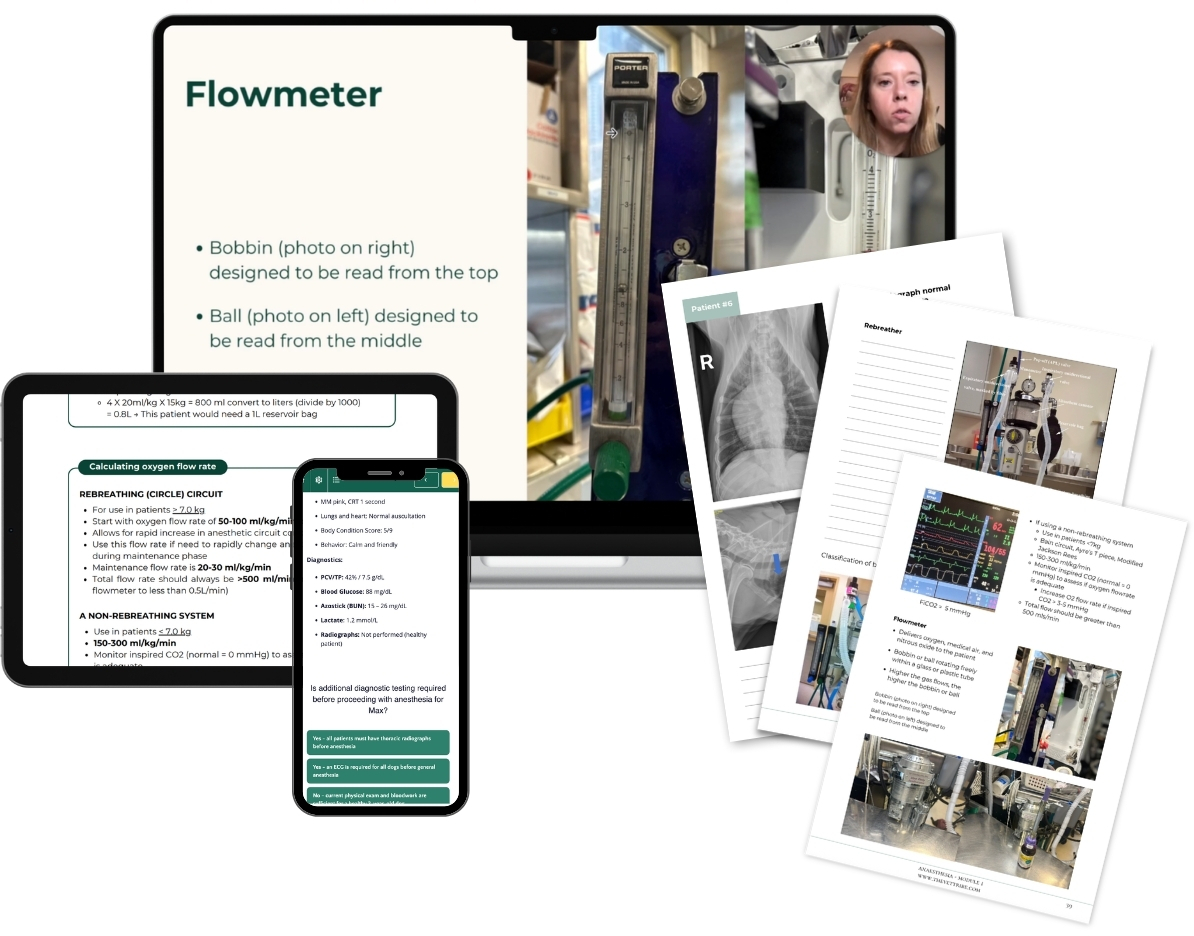
Pre-Anaesthetic Workup

Prepared, not panicked.
Most anaesthetic disasters are decided before the patient is ever induced - which is exactly why a proper workup is the most powerful safety tool you have.
What you will master inside this module:
  • Use imaging appropriately and assign ASA status with confidence
  • Choose and check your machine, circuit, bag size and flow rate for each patient
  • Interpret key bloodwork (PCV, TP, glucose, lactate) and know when to pause your plan
More about this module
  • Run a targeted pre-anaesthetic physical exam and know what your findings mean
  • Take an anaesthesia-focused history - breed flags, medications and fasting
Lessons in this module
Lesson 1
IntroductionA walk-through of what this module covers and how it connects to everyday clinical decision-making. Whether you're handling routine procedures or complex cases, it frames the mindset needed to anaesthetise with intention and confidence.
Lesson 2
Physical ExaminationBefore the monitors, comes your hands, eyes and ears. How to conduct a purposeful pre-anaesthetic exam - heart, lungs, mucous membranes and more - what to listen for, what subtle signs can mean, and how your findings feed into risk assessment and planning.
Lesson 3
Patient History and MedicationsWhat you ask matters. How to take a thorough history with anaesthesia in mind: breed-specific red flags, important medication protocols, and what to do if a patient arrives having just eaten or taken their morning meds.
Lesson 4
BloodworkNumbers tell a story if you know how to read them. Interpret key values like PCV, TP, glucose and lactate in the context of anaesthesia - which findings should pause your plan, when a transfusion might be necessary, and how to spot underlying disease that could complicate recovery.
Lesson 5
ImagingNot every patient needs it, but when they do it matters. How thoracic and abdominal imaging, especially radiographs, play into pre-anaesthetic assessment, with case-based examples to sharpen your eye for aspiration, heart failure or GDV before you proceed.
Lesson 6
Assigning ASA StatusThe ASA system isn't just a label, it's a tool. How to use ASA status to assess anaesthetic risk and communicate it clearly with your team and clients, with real-world examples based on disease severity, urgency and expected outcomes.
Lesson 7
Machine and Equipment SetupA good plan means nothing without the right setup. How to choose and check your equipment - rebreathing vs non-rebreathing circuits, flow rate calculations and bag sizing - so your setup fits your patient's size and condition.
Lesson 8
Case Setup ExamplePutting it all together. Walk through anaesthetic machine selection, bag size calculation and oxygen flow rate determination using real patient examples, bridging theory and practice so prep feels easier under pressure.
By the end of this module, you will feel prepared to assess any patient's anaesthetic risk, prep your machine correctly, assign ASA status and walk a client through the plan with confidence.
Week 1
Week 2
Week 2

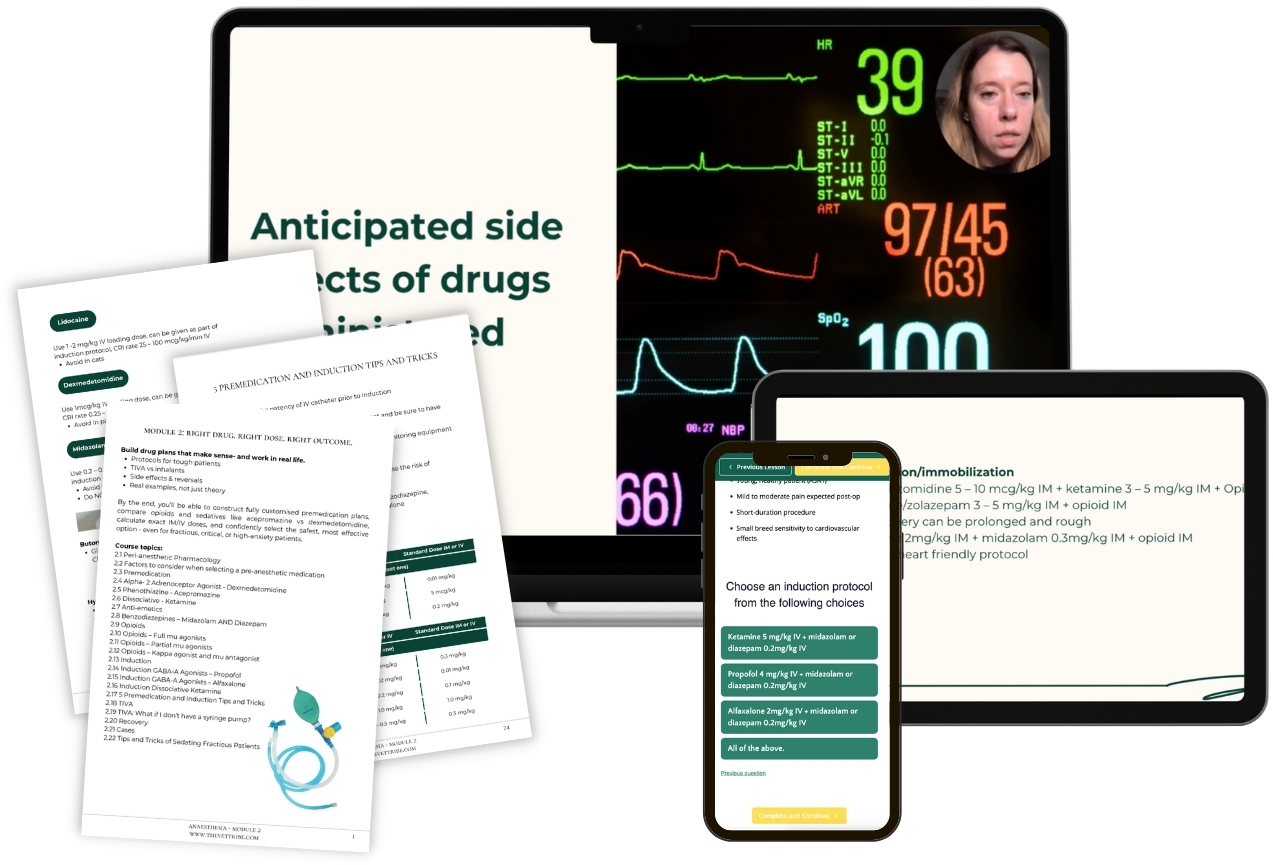
Sedation & Premedication

Right drug. Right dose. Right outcome.
The difference between a smooth anaesthetic and a fight on the table is usually the plan you built before you drew anything up.
What you will master inside this module:
  • Compare and choose between sedatives - dexmedetomidine, acepromazine, ketamine, benzodiazepines
  • Use opioids correctly across full mu, partial mu and kappa agonists
  • Select and dose induction agents (propofol, alfaxalone, ketamine) safely
  • Run TIVA, including without a syringe pump, and manage a smooth recovery
More about this module
  • Build fully customised premedication plans for any patient
  • Calculate exact IM/IV doses, even for fractious or critical patients
Lessons in this module
Lesson 1
Peri-anaesthetic PharmacologyGain a solid foundation in how sedation and premedication drugs work - their effects on the body and how they set the stage for safe anaesthesia.
Lesson 2
Factors to Consider When Selecting a Pre-anaesthetic MedicationThe key factors that guide your drug choices, from patient health status to procedure type, so you can build a thoughtful, case-specific plan.
Lesson 3
PremedicationWhy premedication matters and how it improves patient comfort and safety, including timing, routes of administration and common protocols.
Lesson 4
Alpha-2 Adrenoceptor Agonist - DexmedetomidineHow dexmedetomidine works, when to use it, and how to manage its effects - and why it's a valuable tool in many anaesthetic plans.
Lesson 5
Phenothiazine - AcepromazineThe pharmacology of acepromazine and its role in sedation, with dosing guidelines, benefits and precautions to avoid complications.
Lesson 6
Dissociative - KetamineGet confident using ketamine safely - its analgesic and anaesthetic properties, plus key considerations in different patients.
Lesson 7
Anti-EmeticsHow and when to use anti-emetics to reduce nausea and vomiting risks before anaesthesia, including common options and dosing strategies.
Lesson 8
Benzodiazepines - Midazolam and DiazepamHow benzodiazepines fit into premedication plans - their calming effects, advantages and when they're most appropriate.
Lesson 9
OpioidsWhy opioids are the backbone of analgesia in anaesthesia - the different classes, their mechanisms, and how to integrate them into balanced protocols.
Lesson 10
Opioids - Full Mu AgonistsA deeper look at full mu agonists like fentanyl, hydromorphone and morphine - indications, benefits and monitoring for side effects.
Lesson 11
Opioids - Partial Mu AgonistsHow partial mu agonists provide moderate analgesia with fewer side effects, and their role in specific patients and procedures.
Lesson 12
Opioids - Kappa Agonist and Mu AntagonistHow drugs like butorphanol can be used for mild pain relief and sedation, with dosing and practical applications.
Lesson 13
InductionPrepare for smooth induction - patient preparation, drug administration and airway management basics.
Lesson 14
Induction GABA-A Agonists - PropofolHow propofol works for induction and maintenance, with dosing, administration techniques and how to avoid complications.
Lesson 15
Induction GABA-A Agonists - AlfaxaloneUsing alfaxalone as an induction agent - its advantages, limitations and clinical tips.
Lesson 16
Induction Dissociative - KetamineHow ketamine can be used for induction, alone or combined, with practical dosing and when to consider it over other agents.
Lesson 17
Premedication and Induction Tips and TricksExpert tips to make premedication and induction safer and more predictable, so you can troubleshoot challenges in real time.
Lesson 18
TIVATotal Intravenous Anaesthesia and when it's appropriate - how to create balanced protocols and monitor your patient effectively.
Lesson 19
TIVA - What if I Don't Have a Syringe Pump?Clear guidance on delivering TIVA without a syringe pump, including practical alternatives and how to calculate infusion rates safely.
Lesson 20
RecoveryMaster the recovery phase - how to monitor patients, manage pain and anticipate complications as they wake from anaesthesia.
Lesson 21
CasesApply everything to real-world scenarios, working through detailed cases that bring pharmacology, planning and patient care together.
By the end of this module, you will feel prepared to build a fully customised premed and induction plan, calculate exact doses, and choose the safest option even for fractious, critical or high-anxiety patients.
Week 3

Induction & Airway Management

No more white-knuckle intubations.
The minutes around induction are where a calm anaesthetic can unravel fastest - and where a clear, rehearsed routine matters most.
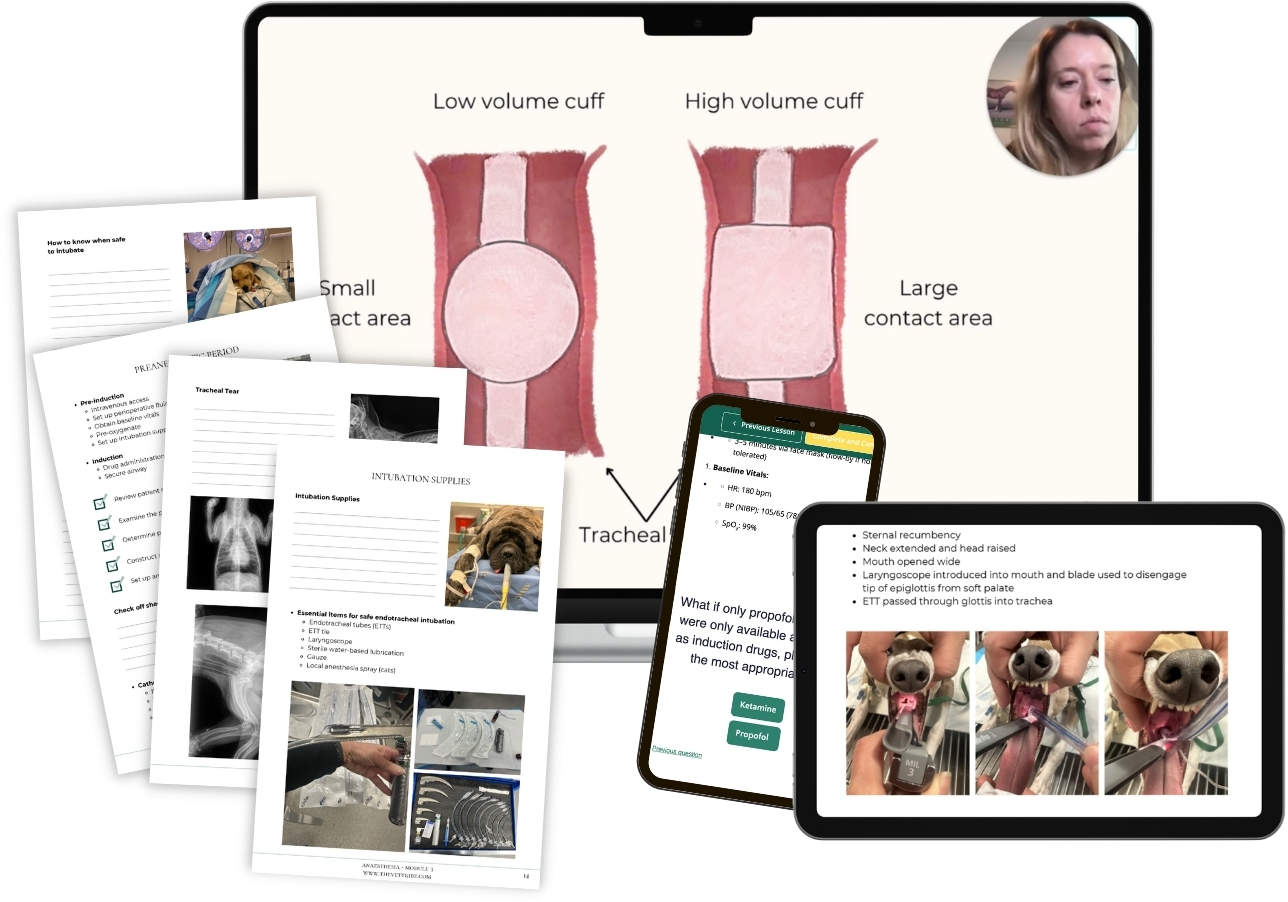
What you will master inside this module:
  • Induce smoothly and confirm a secure airway
  • Perform intubation step by step, and recognise and manage complications
  • Prepare your patient and set up peri-anaesthetic fluids, including adding dextrose safely
More about this module
  • Record baseline values and pre-oxygenate correctly before induction
  • Have the right intubation supplies ready and checked every time
Lessons in this module
Lesson 1
Pre-anaesthetic PeriodHow to prepare your patient before induction - reviewing records, checking equipment and confirming plans so you can start with confidence.
Lesson 2
Peri-anaesthetic Fluid TherapyHow to calculate, set up and monitor fluids during anaesthesia - why fluid support is critical and how to tailor rates to each patient.
Lesson 3
Adding Dextrose to a Fluid BagStep-by-step instructions for safely mixing dextrose into fluids, including calculations, technique and common pitfalls to avoid.
Lesson 4
Baseline ValuesKnow your starting point before induction - which vital signs to record, why they matter, and how they help detect problems early.
Lesson 5
Pre-oxygenationThe benefits of oxygen supplementation before induction, how to perform pre-oxygenation effectively, and when it's most important.
Lesson 6
Intubation SuppliesBe ready with the right tools every time - what you need for safe intubation and how to check your equipment is functioning properly.
Lesson 7
InductionHow to induce anaesthesia smoothly - dosing, patient positioning and strategies to minimise stress and complications.
Lesson 8
How to Confirm IntubationHow to be certain your airway is secure - reliable ways to confirm tube placement, and what to do if it's not correct.
Lesson 9
IntubationA clear, stepwise guide to performing intubation, with tips for improving technique and troubleshooting common challenges.
Lesson 10
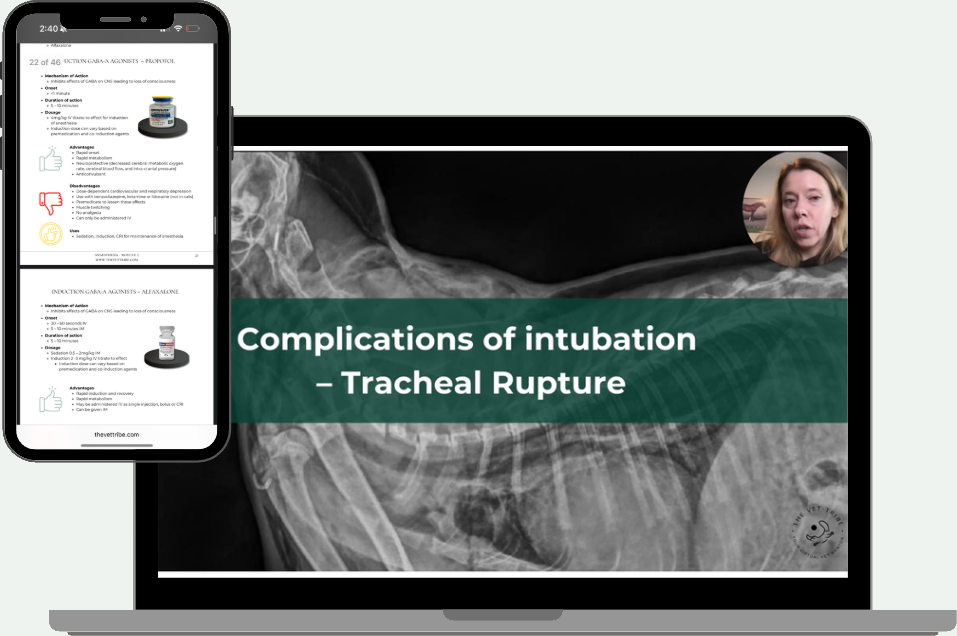
Complications of IntubationHow to recognise, prevent and respond to complications during airway management.
By the end of this module, you will feel prepared to move a patient calmly from sedation to a secured airway, pre-oxygenate and induce correctly, and troubleshoot a difficult intubation without panic.
Week 3
Week 4
Week 4

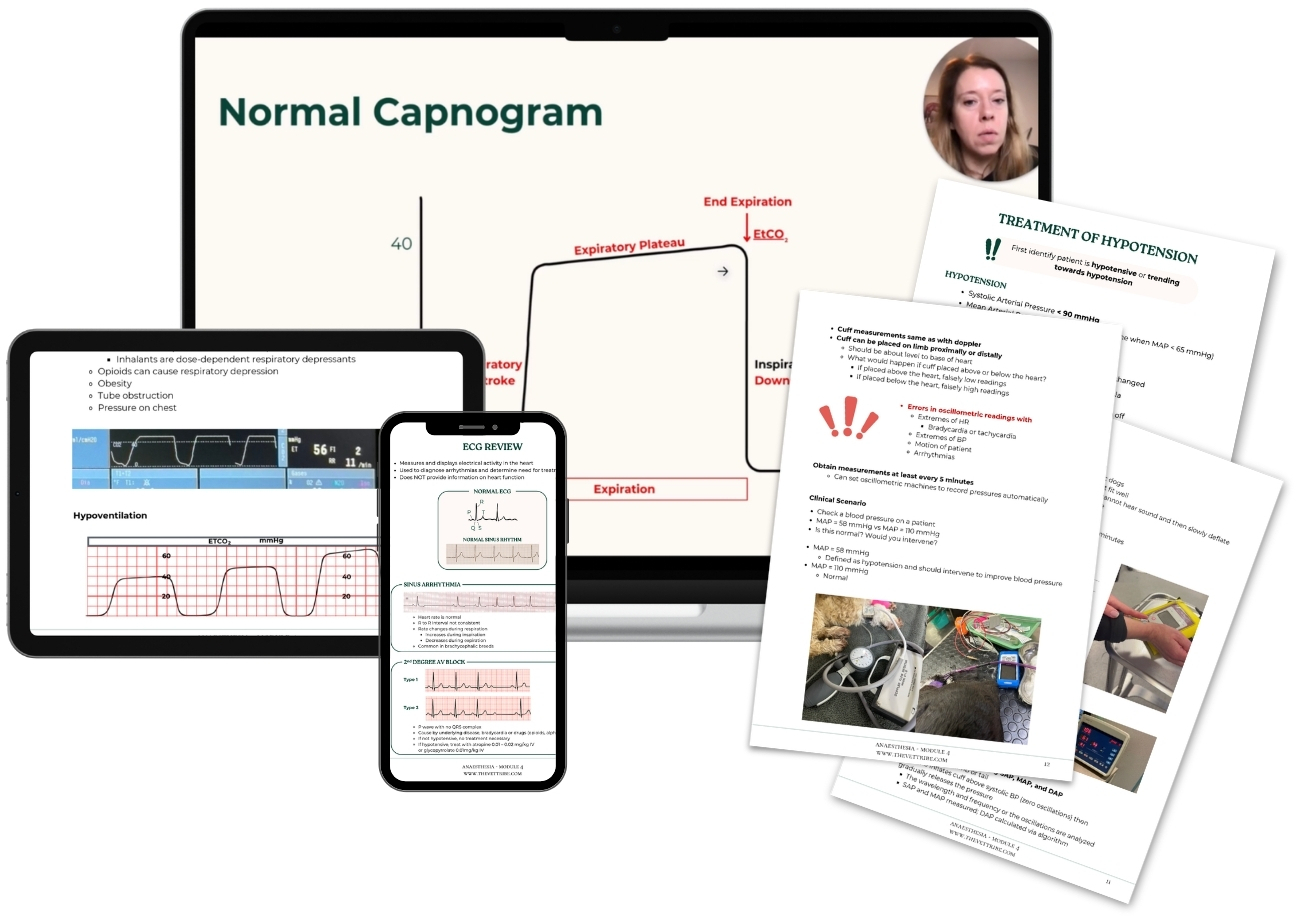
Intraoperative Monitoring & Complications

Read the signs. Stay calm. Take action.
Under anaesthesia, the patient can't tell you something is wrong - the monitor does, but only if you know how to read it before the numbers become a crisis.
What you will master inside this module:
  • Detect and manage hypotension to protect perfusion
  • Read capnography and manage hypo-, hyper- and normal ventilation
  • Recognise and respond to arrhythmias
  • Tell pain, light anaesthesia and dysphoria apart, and detect and treat hypoxaemia
More about this module
  • Interpret monitoring data together - heart rate, blood pressure, oxygenation and depth
  • Prevent hypothermia and support recovery
Lessons in this module
Lesson 1
IntroductionGet oriented to the goals of monitoring under anaesthesia, and why vigilance is the most important safeguard for your patient.
Lesson 2
MonitoringHow to interpret monitoring data and recognise early signs of trouble - heart rate, blood pressure, oxygenation and depth of anaesthesia.
Lesson 3
HypotensionHow to detect and manage low blood pressure during procedures, with practical steps to protect perfusion and prevent complications.
Lesson 4
TemperatureWhy temperature drops under anaesthesia and how to prevent hypothermia, with simple strategies to maintain warmth and improve recovery.
Lesson 5
HypoventilationWhat causes hypoventilation and how to respond - recognising changes in CO2 and supporting ventilation effectively.
Lesson 6
HyperventilationHow to identify hyperventilation, why it matters, and how to adjust your plan when CO2 drops too low.
Lesson 7
Normal VentilationWhat healthy ventilation looks like - normal ranges and how to confirm your patient is breathing effectively.
Lesson 8
ArrhythmiasRecognise and respond to arrhythmias confidently - bradycardia, tachycardia, and when to intervene.
Lesson 9
Pain and Surgical StimulationHow surgical stimulation impacts your monitoring parameters, and how to distinguish pain responses from other causes of change.
Lesson 10
HypoxemiaClear strategies for detecting and treating low oxygen levels, with troubleshooting tips and when to escalate care.
Lesson 11
CasesApply your skills in realistic scenarios that build problem-solving, interpretation and response planning.
By the end of this module, you will feel prepared to spot abnormal trends early, read vital signs in context, and follow a clear plan to manage the most common complications before they spiral.
Week 5

Case-Based & Real-World Application

The difference between knowing and doing.
Knowing the drugs and the numbers is one thing - holding it all together on a real, awake-and-anxious patient is the skill this module is built to give you.
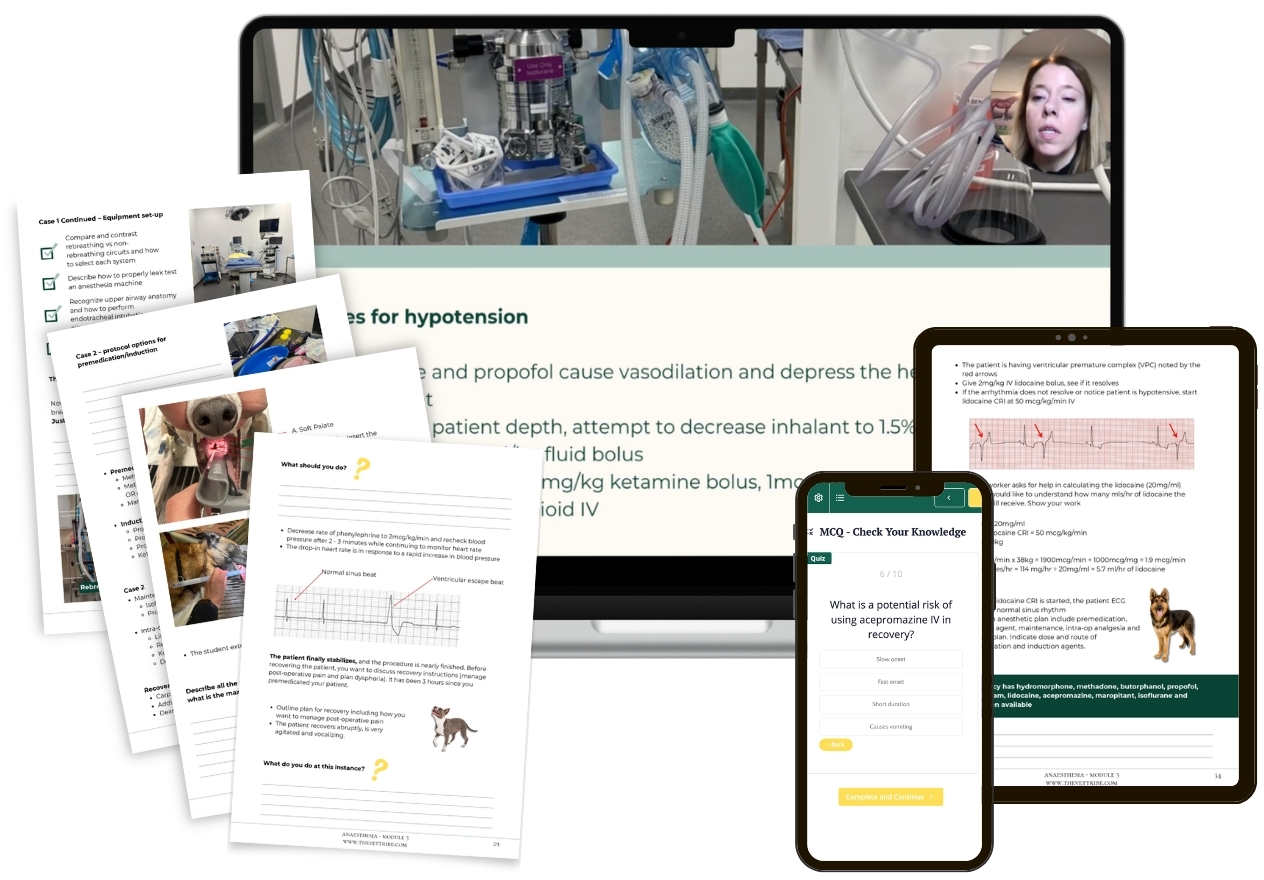
What you will master inside this module:
  • Build complete anaesthetic protocols from drug choice through to recovery
  • Make confident calls on drugs, fluids, machine setup and complications
  • Interpret ECGs and intra-op changes, and adapt your plan on the fly
More about this module
  • Recover patients safely with a clear, stress-free plan for pain
Lessons in this module
Lesson 1
IntroductionBring together everything you've learned, and how to approach real cases with confidence and create safe, thoughtful plans.
Lesson 2
Case #1Work step by step through a straightforward surgical case - building an anaesthetic protocol, selecting drugs and preparing equipment.
Lesson 3
Case #2A more complex patient scenario - how to adjust plans for comorbidities, special considerations and higher-risk factors.
Lesson 4
Case #3A case that includes unexpected changes - how to adapt quickly, troubleshoot issues and keep the patient stable.
By the end of this module, you will feel prepared to build a complete anaesthetic plan for a real patient, manage what happens intra-op, and recover them safely and calmly.
Week 5

Week 6 Examination

The exam can be accessed any time after you complete the course materials. You'll have three attempts, each limited to two hours, and your result appears instantly. Score at least 70% to receive your personalised certificate signed by Dr Kristi Kobluk DACVAA.
Secure your spot
6-week guided learning · 12 CPD points · risk-free
What to expect each week

Every step is designed to help you learn faster, remember more, and act with confidence in the clinic.

Start with a quiz

Each module begins with a quick quiz to see what you already know.

Learn from specialists

Short, practical videos from a board-certified specialist.

Take notes in your workbook

Download the module workbook to capture key points and charts.

Quizzes & case studies

Go through case studies and apply your knowledge in realistic scenarios.

Ask your questions

Post in the community - specialists have your back.

Extra tools & resources

Protocols, articles, tables and guides if you want to dig deeper.

Everything you get
Learn from Anywhere

Learn from Anywhere

Join today, learn online at your own pace. 6 weeks of guided modules + 6 months access.

Ask Questions

Ask Questions

Not just video lessons - mentors are present to answer your questions as you learn.

Video Lessons

Video Lessons

Over 12 hours of training in short 5-20 minute videos for any schedule.

Learning Materials

Learning Materials

Downloadable notes, diagrams, drug charts and a workbook.

Track Progress

Track Progress

Pre- and post-module MCQs that measure progress and keep knowledge sharp.

Case Studies

Case Studies

Realistic scenarios to help you apply skills in real-world contexts.

24/7 Community

24/7 Community

A private space where vets connect and learn together.

Exam & Certificate

Exam & Certificate

Pass the online MCQ exam with 70%+ to earn your official certificate.

55+
video lessons
100+
quizzes
215+
page workbook
20+
charts & PDFs
12
RACE & AVA points
24/7
online access
T
Created 3d
Anaesthesia
Blood Pressure Cuff Placement
Hi, I would just like to confirm my understanding. So, when the BP is measured at the level of the heart it should mean that it has...
3 👁
H
Created 13d
Anaesthesia
Drugs unavailability in some countries
Some anaesthetic and analgesic drugs such as Hydromorphone, Methadone, and Alfaxalone may not be available in certain clinical settings. In such situations, what alternative anaesthetic protocols can be used? According t... read more
1   16 👁
M
3d 🕐   1 💬
Ask your mentor

Your mentors aren't just names on a screen

Throughout the course, you can post your questions directly inside the platform and get clear, practical answers from board-certified specialists. You're never working through it alone.

What vets say about The Vet Tribe

You don't have to take our word for it. Here are a few words from vets and students who have already joined.

★★★★★

"I can honestly and genuinely say that I'm loving it and I actually look forward to spending an hour or two every week to sit down and do the lessons. It's really interactive learning."

@droliviaclarke
★★★★★

"I took the anesthesia course and found it a perfect balance between establishing and reinforcing the basics of what I had learned in vet school. Highly recommend!"

@thevetsoapbox

Want to hear more from our vets? See all testimonials

Choose your cohort

Pick your start date and save your spot

We run Essentials of Anaesthesia in small guided cohorts so Dr Kobluk and the team can properly support everyone and answer real clinical questions along the way. Enrolment for the next cohort is open now, and you get full access the day yours begins - so you can plan your six weeks around the shifts you're already working. Once a cohort's start date passes, the next chance to join is the following month.

Select your start date

Choose how to pay

A$1289.00 +tax
pay in full
2 × A$644.50 +tax
monthly
4 × A$322.25 +tax
monthly
Risk-free enrolment No interest, no hidden fees Secure checkout
How your cohort works

Your cohort starts on its scheduled date, and that's the day your access opens and Module 1 unlocks. From there, a new module unlocks each week across the six weeks of guided learning, so you have time to absorb each topic before moving on. You keep full access to every recording and resource for six months, so you can revisit lessons and protocols whenever a real case calls for it. Throughout your cohort, Dr Kobluk and the team are there in the community to answer your questions - you're never working through it alone.

100%
MONEY-BACK
GUARANTEE
Try it risk-free

We've got your back

We believe in the quality of our courses and we stand behind them. If you start your intake and decide it isn't the right fit, just let us know before Module 2 unlocks and we'll refund you in full - no questions asked. You only stay if this genuinely helps you in practice.

✓ Full refund before Module 2 ✓ No questions asked ✓ No interest, no hidden fees

This course is for you if...

  • You want to handle anaesthesia with confidence when seconds matter
  • You're a vet or final-year vet student who wants to feel calm and in control under anaesthesia
  • You prefer practical, case-based learning over theory-heavy lectures
  • You want checklists, decision trees and drug plans you can use tomorrow
  • You want to learn directly from a board-certified specialist, without the fluff

This course is not for you if...

  • You're not a veterinarian or vet student
  • You're looking for a casual, theory-heavy course with no application to real cases
  • You prefer live-only teaching over structured, on-demand learning
  • You're not ready to commit to practising what you learn through quizzes and case studies

Why learn from Dr Kristi Kobluk?

Trusted mentor in veterinary anaesthesia and analgesia
  • Board-certified specialist - Diplomate of the American College of Veterinary Anesthesia and Analgesia (DACVAA)
  • Experienced teacher & mentor - known for turning complex anaesthetic concepts into practical steps vets can use immediately
  • Practising at a top New York referral centre - real-world experience from a fast-paced, high-level clinical environment
  • Real-world specialist - brings hands-on anaesthesia experience from a busy, high-level referral practice
  • Approachable mentor - valued for her calm, supportive teaching style
Mentor portrait
Not ready yet? Start with a free lesson

TIVA Without a Syringe Pump

We'll send the Open Protocols: Anaesthesia PDF straight to your inbox, plus a free video lesson on how to perform TIVA without a syringe pump. Created and taught by Dr Kristi Kobluk DACVAA.

Get the free lesson →
Free lesson
Join the course

Essentials of Anaesthesia

Learn with Dr Kristi Kobluk DACVAA and build the confidence to handle emergencies calmly and effectively.

  • 6-week guided learning, 6 months access
  • Over 12 hours of training in short videos
  • Direct Q&A with a board-certified specialist
  • Interactive case studies, quizzes & protocols
  • Certificate after passing the final exam
  • 24/7 access to The Vet Tribe community
12 CPD points · RACE and AVA approved
Secure your spot
Course thumbnail
Frequently asked questions
When does my course start?

Your course starts on the day your chosen cohort begins - you'll see the available start dates in the enrolment box above. That's the day your access opens and Module 1 unlocks. A new module then unlocks each week across the six weeks.

Are the lessons live?

No. All teaching is delivered as pre-recorded videos (5-20 minutes each) grouped into weekly modules, about two hours of content per module. No time-zone clashes and no 5 a.m. alarms.

Do I get all modules at once?

No. The course releases one module each week so you have time to absorb each topic. Module 1 unlocks the day your cohort starts, then a new module every seven days. You keep access to all content for six months from your cohort start date.

Will I have contact with the mentor?

Yes. You'll be part of The Vet Tribe Community on our website or app, where you can ask questions and get answers from mentors and the wider community. You won't be learning alone.

How long do I keep access?

You'll have full access for six months from your cohort start date. Learn at your own pace, revisit modules, and stay connected the whole way through.

Have more questions? Visit our full FAQ page or get in touch - we're happy to help.

Join the Essentials of Anaesthesia online course

Learn with Dr Kristi Kobluk DACVAA and build the confidence to handle anaesthesia calmly and effectively. Secure your spot while places last.

Secure your spot
0:00